

Username: Password:
Welcome! Please Sign In or Register
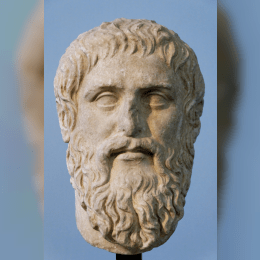
Born in ~427 B.C. in Athens, Greece, Plato (aka Aristocles) was one of the greatest and most well known ...
Read More
Item added by VirileVagabond. Added on 11/08/2003
RSS Icon

3 Reviews

abichara
11/04/2009

Plato 5

It would be fascinating to bring ancient thinkers like Plato, Aristotle, Cicero, Augustine, Acquinas, and a few others into our present time and let them observe our modern culture.

Plato would be a particularly fascinating interview. It would be a dialog, not a one way form of communication by any stretch.

Although his views of government are utterly impractical, his Theory of the Forms is the base point of all Western Philosophy. It would be interesting to see his take on our modern culture and how many aspects of modern philosophy are really a reflection of his own thought, whether for or against. Either you love Plato or despise him, very little in between.

The starting point of Plato's thought is "The Allegory of the Cave", Plato's famous analogy about hidden truths that are masked underneath the reality of our existence. It's really profound stuff.

In the allegory, Plato imagines that human beings are chained for the duration of their lives in an underground cave, knowing nothing but darkness. The only thing they can see is the cave wall, where the shadows of the world above are reflected. They believe that these flickering shadows are reality. Plato then assumes that one of the prisoners are freed and brought into the sunlight. Upon his release, he suffers great pain. Blinded by the glare of natural light, he is unable to see anything and longs for the familiar darkness of the cave. But eventually his eyes adjusts to the light. The illusions of the tiny shadows is obliterated. He confronts the chaos, complexity, and confusion that is reality. The world is no longer drawn in the simple silhouettes of shadows. But upon his return to the cave, he's despised. He can no longer see in the dark as he used to. Those who never left the cave ridicule him and swear never to go into the dark lest they be blinded as well.

Throughout The Republic, Plato demonstrates a great fear of the power of entertainment, the power of the senses to overthrow the mind, the power of emotion to destroy reason. The people who are in the cave are the one who live as slaves to ancient superstitions, who lack a complete understanding of the world at large. When someone tries to illuminate them, the messenger from the outside world is hated for bringing truth.

That's what lead Socrates (who died while "speaking truth to power" in the face of the decline of Athenian democracy) to say "As for the man who tried to free them and lead them upward, if they could somehow lay their hands on him and kill him, they would do so."

This is why I think an interview with Plato would be fascinating even today. These are ancient truths that still have direct applications to today. In our modern culture, I'd argue that the "flickering shadows" is celebrity culture, the spectacle of arena and the airwaves; the lies of advertising, the endless personal dramas, many of them completely fictional, that have become a staple of the news, celebrity gossip, New Age mysticism, and pop psychology. All of these things hide essential truths rather than illuminate them. In modern culture, the fabricated, the inauthentic, the theatrical has displaced the natural, the genuine and the spontaneous; indeed, reality itself has been reduced to stagecraft itself.

Increasingly, we live in a world where fantasy is more real than reality, paradoxically. We are a high illusioned society. Yet we dare not become disillusioned because our illusions are the very house (cave?) in which we live in; they are our news, our heroes, our adventure, our forms of art, our very experience as humans. Guess why the freed prisoner was hated once he returned to the cave. He was able to see the absurdity of it all!

Today those who manipulate the shadows are publicists, marketing departments, promoters, TV writers, pollsters, TV personalities and celebrities, and others associated with showbiz. They are the puppet masters who create the shadows on the walls of the cave that is our modern culture.

Perhaps things haven't changed as much as we're lead to believe. I think that would probably be Plato's take on it!

Add your vote! 1 Helpful / 0 Funny / 1 Agree / 0 Disagree

CanadaSucks
07/16/2008

Plato 3

As an interview, Plato would be interesting. Attempting to have a 'dialogue' with him would be tough. But his ideas and contempt for actual democracy would wear thin. . .and we tend to overrate past intellectual greats on occasion- I know much more about the physical world and universe than Plato ever did. Still, as a giant of philosophy he can't merit lower than a 3.

Add your vote! 1 Helpful / 0 Funny / 0 Agree / 0 Disagree

X Factor Z
04/23/2005

Plato 5

Some questions about Atlantis.

Add your vote! 0 Helpful / 0 Funny / 0 Agree / 0 Disagree

3 reviews!     « Previous  |  Page    of  1  |  Next »

view stats
4.25
average based on 4 ratings